
Home / Enterprise Data Architecting Advisory Services
Transition legacy data warehouses, fragmented data lakes, and complex database topologies into unified, scalable, cloud-native architectures. Aurastell delivers strategic data architecting advisory, zero-downtime migration, automated data pipeline engineering, and governance-first frameworks that transform complex enterprise data assets into high-performance decision intelligence.
In today’s hyper-connected digital economy, enterprise agility is directly governed by the structural integrity of its underlying data architecture. As global organizations scale their digital footprints across cloud-native platforms, legacy ERP software, edge sensors, and third-party SaaS ecosystems, the sheer volume, velocity, and variety of data can quickly outpace architectural capabilities.
Without a modern, architected data strategy, enterprise data environments degrade into disconnected silos, suffer from conflicting key performance indicator (KPI) definitions, introduce severe query latency, and incur ballooning cloud infrastructure expenses. Furthermore, as enterprises race to deploy Generative AI, Retrieval-Augmented Generation (RAG) frameworks, autonomous agents, and real-time computer vision applications, fragile legacy data setups become the primary bottleneck to digital transformation.
Data Architecting Advisory is the strategic and technical discipline that aligns an organization’s business vision with its underlying technology infrastructure. It defines how data is ingested, structured, stored, governed, and served across the enterprise.
At Aurastell, our Data Architecting Advisory practice bridges high-level executive strategy with low-level software engineering execution. We partner with mid-market and Fortune 500 enterprises to design scalable lakehouse architectures, execute zero-downtime database migrations, automate high-throughput ETL/ELT streaming pipelines, and embed unified governance models directly into the technology stack. Guided by strategic ecosystem partnerships and proprietary migration tools, we help technology leaders eliminate technical debt, prevent data proliferation, and establish an AI-ready data foundation.
Our advisory and engineering services address the complete lifecycle of enterprise data infrastructure, delivering structural clarity, extreme scalability, and predictable operating costs:
We design and execute zero-downtime, risk-mitigated migrations from legacy on-premises data warehouses (Oracle, Teradata, IBM DB2, Netezza, Sybase) and legacy data lakes to modern cloud platforms—including Databricks, Snowflake, Microsoft Azure, Amazon Web Services (AWS), and Google Cloud Platform (GCP).
Structuring modern cloud environments where storage capacity scales independently from compute processing, preventing ballooning costs during heavy query bursts.
Structuring cloud targets into clean Bronze (Raw Ingestion), Silver (Cleansed/Normalized), and Gold (Curated Dimensional Models) layers to ensure complete auditability and data lineage.
Engineering cloud-agnostic architectures that prevent vendor lock-in and allow workloads to run seamlessly across AWS, Azure, and GCP.
Migrating legacy stored procedures, proprietary SQL scripts, and complex ETL jobs manually is slow, error-prone, and expensive. Aurastell leverages proprietary migration accelerators (such as MigrateMate) to streamline cloud architecture transitions:
Automatically converting legacy PL/SQL, T-SQL, and proprietary ETL scripts into modern, version-controlled dbt models, PySpark jobs, and optimized SQL dialects.
Utilizing automated dependency mapping, automated schema transpilation, and parallel execution engines to reduce migration timelines by up to 60%
Deploying asynchronous Change Data Capture (CDC) and dual-run parallel execution environments to ensure core production applications experience zero downtime during final cutover.
Modern analytics and AI applications demand sub-second data freshness. We build fault-tolerant batch and real-time streaming pipelines for both structured and unstructured data assets:
Engineering real-time event ingestion using Apache Kafka, AWS Kinesis, Azure Event Hubs, and Debezium CDC.
Processing heavy unstructured feeds—including video streams, LiDAR point clouds, CAD schematics, PDFs, and IoT sensor streams into clean, indexed formats ready for vector stores and spatial digital twins.
Implementing declarative pipeline orchestration engines (dbt, Apache Airflow, Dagster) with built-in retry logic, schema drift handling, and Dead-Letter Queues (DLQ).
Technical speed without governance leads to data proliferation—a scenario where different business units create conflicting metrics and isolated data copies. Aurastell embeds governance directly into the architectural blueprint:
Designing centralized data modeling layers that eliminate shadow databases and redundant reporting silos.
Standardizing common metric definitions (e.g., Customer Lifetime Value, Net Revenue, Active Fleet) directly in the data warehouse layer before serving BI tools or AI models.
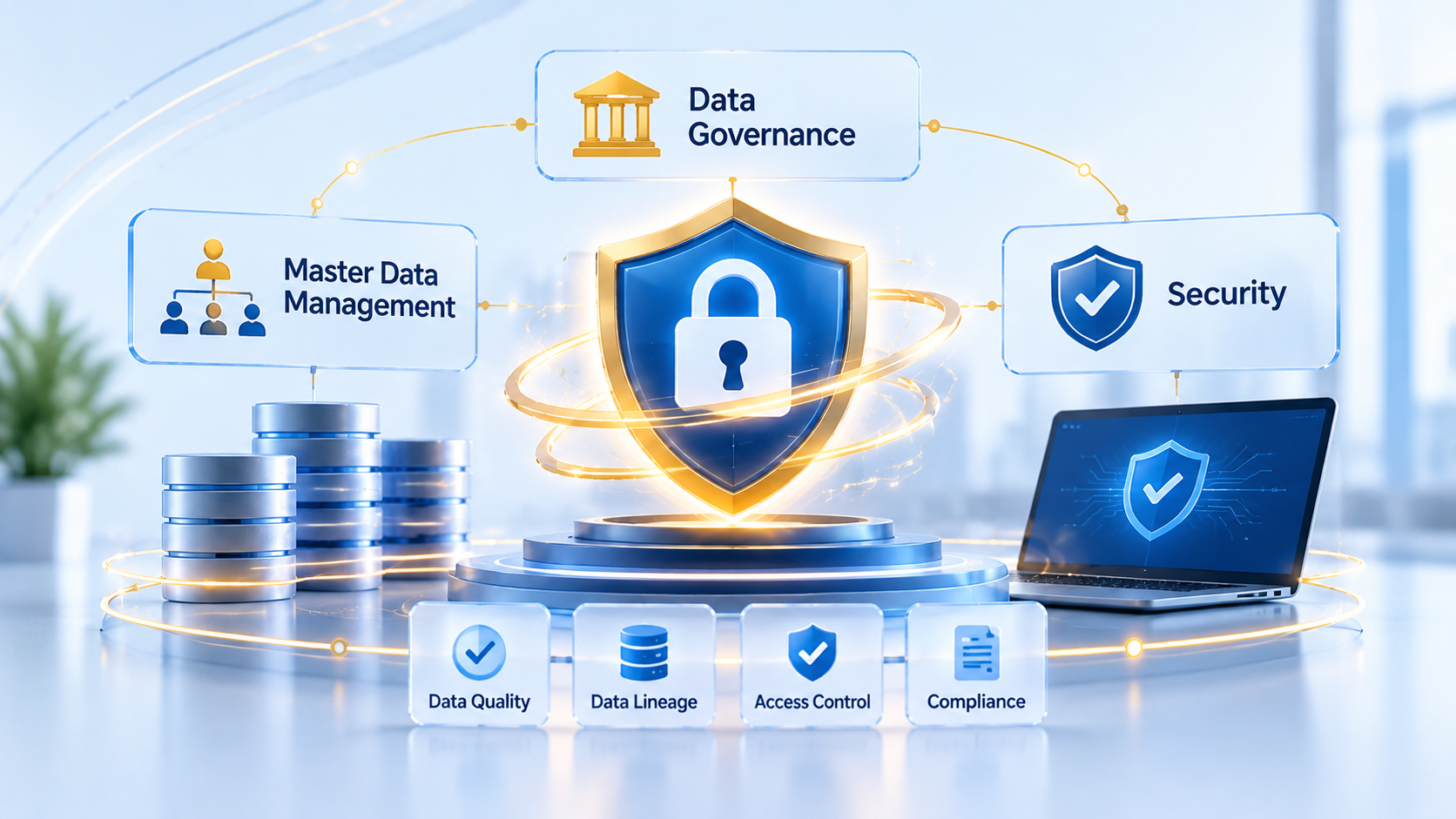
Enforcing Role-Based Access Control (RBAC), Column/Row-Level Security, and automated inline masking of Personally Identifiable Information (PII) to meet ISO 27001, SOC 2, GDPR, and HIPAA compliance.
A successful data architecture advisory practice requires deep technical specialization and direct platform alignment. Aurastell maintains dedicated Centers of Excellence (CoE) and premier partner status across industry-leading cloud data platforms:
Operating a specialized CoE powered by hundreds of certified lakehouse engineers, Spark optimization leads, and MLflow practitioners who specialize in building large-scale unified analytics and Generative AI platforms on Databricks Delta Lake.
Maintaining premier partnership status with leading cloud platforms (Snowflake, AWS, Microsoft Azure, Google Cloud), ensuring our architectural designs leverage the latest feature releases, native security integrations, and performance optimizations directly from platform vendors.
Deep technical commitment to open software standards including dbt, Apache Spark, Delta Lake, Apache Iceberg, Apache Airflow, and Parquet guaranteeing long-term software portability and zero platform lock-in.
Without an engineered data architecture, enterprise technology stacks accumulate technical debt and suffer from operational friction. We systematically eliminate the structural bottlenecks holding organizations back:
Operational & Commercial Risk
Business units create conflicting spreadsheet reports and localized data marts, eroding executive trust in corporate metrics.
Operational & Commercial Risk
Legacy batch ETL scripts take hours or days to process, forcing executives to make strategic decisions based on historical data.
Operational & Commercial Risk
Unpartitioned storage, unindexed queries, and continuous compute cluster execution drive up cloud bills exponentially.
Operational & Commercial Risk
Upstream database schema changes break custom ETL scripts, causing undetected data drop-offs and broken BI dashboards.
Operational & Commercial Risk
Data is isolated in proprietary formats, preventing data scientists from training machine learning models or deploying RAG agents.
Data Architecting Advisory delivers transformational competitive advantage across diverse enterprise verticals where operational speed, multi-source data, and strict scale intersect:

The Strategic Challenge: A global logistics provider was constrained by an on-premises transactional database that took 5 hours to generate daily fleet tracking and cargo dispatch reports.

The Strategic Challenge: An industrial manufacturer had decades of machine telemetry trapped in proprietary historian databases, preventing the deployment of predictive maintenance models and spatial digital twins.
The Strategic Challenge: A healthcare network struggled with isolated patient records across legacy SQL databases, hindering clinical research, claims reconciliation, and HIPAA compliance audits.

The Strategic Challenge: A multi-national retailer needed to combine legacy point-of-sale (POS) transactions, web clickstream logs, and in-store computer vision foot-traffic heatmaps into a unified recommendation engine.
Our structured, 6-stage delivery methodology guarantees high technical availability, strict data fidelity, and zero operational disruption during architectural modernization:
Profiling legacy source databases, evaluating data quality, mapping upstream/downstream software dependencies, and assessing security limits.
Designing canonical target schemas, Medallion lakehouse structures, cloud security boundaries, and normalized KPI definitions.
Leveraging automated migration accelerators (MigrateMate) to convert legacy stored procedures, ETL scripts, and schemas into modern dbt/PySpark pipelines.
Ingesting bulk historical data while activating Change Data Capture (CDC) to stream live transactional updates to the cloud target asynchronously.
Executing mathematical row-by-row reconciliation algorithms to verify 100% data fidelity, performing DNS cutovers, and routing live applications to the cloud target.
Implementing real-time monitoring tools (Datadog, Monte Carlo) to track pipeline execution SLAs, query latencies, data freshness, and auto-scaling compute budgets 24/7/365.
Enterprise leadership selects Aurastell as their Data Architecting Advisory partner because we replace technical uncertainty with guaranteed, measurable business outcomes:
By utilizing automated transpilation tools and pre-built architectural blueprints, we compress cloud migration schedules by **up to 60%** compared to manual rewrites.
Asynchronous dual-run streaming replication keeps legacy databases fully operational throughout the migration process until final validation is complete.
We eliminate cloud cost shock by embedding auto-scaling controls, auto-suspending clusters, query timeouts, and columnar storage optimizations from Day 1.
Automated reconciliation engines execute mathematical checks to verify data completeness, schema accuracy, and metric consistency before legacy platforms are retired.
Data Architecting Advisory provides the strategic vision, technical blueprints, and engineering standards needed to align an organization’s business goals with its data infrastructure. Advisory services evaluate legacy environments, design scalable cloud target architectures (lakehouses/warehouses), define governance and security frameworks, and construct phased execution roadmaps that eliminate technical debt and data silos.
A Data Lakehouse combines the structured SQL query performance, ACID transaction reliability, and governance of a traditional Data Warehouse with the low-cost, flexible object storage of a Data Lake. It allows structured transactional data, semi-structured JSON logs, and unstructured video/audio/spatial assets to coexist in a single platform—supporting both traditional BI reporting and advanced AI/ML workloads.
MigrateMate is a proprietary migration acceleration tool that automates complex technical tasks. It automatically parses, translates, and refactors legacy proprietary database code (such as PL/SQL, T-SQL, and legacy ETL scripts) into modern, cloud-optimized dbt models, SQL dialects, and PySpark pipelines—eliminating thousands of hours of manual rewriting.
We deploy dual-run deployment strategies utilizing asynchronous Change Data Capture (CDC). While production systems continue writing to the legacy database, CDC tools capture transaction logs in real time and replicate them to the cloud target asynchronously. Once both systems match with 100% mathematical precision across parallel execution cycles, a seamless cutover is executed without taking core business applications offline.
Data proliferation occurs when business units create isolated data marts and spreadsheets with custom metric formulas. A governance-first architecture establishes a centralized, single-source-of-truth semantic layer in the curated Gold storage layer. Key metrics (such as net revenue or customer retention) are defined once in code, ensuring all BI dashboards, executive reports, and AI models consume identical, normalized metrics.
The Medallion Architecture organizes cloud data logically into three sequential refinement tiers:
A spatial Digital Twin requires continuous, low-latency synchronization between physical equipment and its 3D digital model. Our data architectures build high-throughput IoT streaming pipelines (via Kafka or MQTT) that process high-frequency vibration, thermal, and operational metrics in real time, projecting those live data points directly onto 3D spatial models with sub-second latency.
We enforce declarative cloud cost governance:
Security and compliance are built natively into our architectural blueprints:
Our engineering practice possesses deep expertise migrating across all major legacy platforms—including Oracle, Teradata, IBM DB2, SAP BW/HANA, Microsoft SQL Server, Netezza, Sybase, and legacy mainframe file structures.
Our advisory practice is platform-agnostic. We design and deploy migration targets across all leading cloud data platforms—including Databricks, Snowflake, Amazon Web Services (AWS Redshift/S3), Microsoft Azure (Synapse/Fabric/Data Lake), and Google Cloud Platform (BigQuery).
Timelines depend on enterprise data complexity and scope:
We conduct a pre-project Total Cost of Ownership (TCO) evaluation that quantifies direct savings from retired legacy hardware maintenance, eliminated proprietary software licenses, reduced manual data preparation labor, and optimized cloud query performance. Most enterprise clients achieve full cost-parity and positive ROI within 12 to 18 months.
Executive leadership receives a complete Enterprise Data Modernization Package: