
Home / Enterprise Data Analytics & Business Intelligence Services
Unify fragmented data architectures, automate high-speed ingestion pipelines, and empower your enterprise with real-time analytics, cloud BI solutions, and decision-grade business intelligence.

In today's hyper-connected economy, operational speed is directly tied to analytical velocity. Midsize and enterprise-grade organizations generate massive volumes of transactional, customer, and operational data every second. However, when this data remains locked in disparate applications, legacy databases, and isolated spreadsheets, leadership teams face severe decision latency. Delayed insights mean missed market opportunities, unaddressed operational bottlenecks, and degraded customer experiences.
Data Analytics & Business Intelligence (BI) is no longer a passive retrospective reporting function; it is the strategic operational nervous system of the modern enterprise. True enterprise intelligence requires moving from static end-of-month reports to sub-second streaming analytics and centralized cloud BI ecosystems.
At Aurastell, our Data Analytics & Business Intelligence practice bridges the gap between complex software environments and high-impact business decisions. Led by experienced Data Architects, Integration Engineers, and BI Specialists, we engineer automated data software pipelines, modern cloud data warehouses, and interactive visualization platforms. By replacing fragile, manual data handoffs with resilient, automated streaming architecture, we ensure your leadership acts on a single, verified, and real-time source of truth.
Without an architected data strategy, enterprise software stacks degrade into unmanageable data silos that introduce risk and inflate operational expenses. We systematically eliminate the core bottlenecks restricting enterprise agility:
Operational Impact
Core metrics are trapped across isolated ERP, CRM, SCM, and line-of-business applications.
Operational Impact
Legacy batch jobs (FTP/ETL) mean reports reflect historical data rather than live operational conditions.
Operational Impact
Contradictory definitions across departments erode executive trust in business intelligence dashboards.
Operational Impact
Unoptimized query structures and unpartitioned data stores inflate cloud compute and database costs.
Operational Impact
Ungoverned, decentralized data access exposes organizations to severe regulatory and data privacy risks.
To build a synchronized, real-time intelligence ecosystem, our practice unifies the four foundational pillars of modern data software engineering:
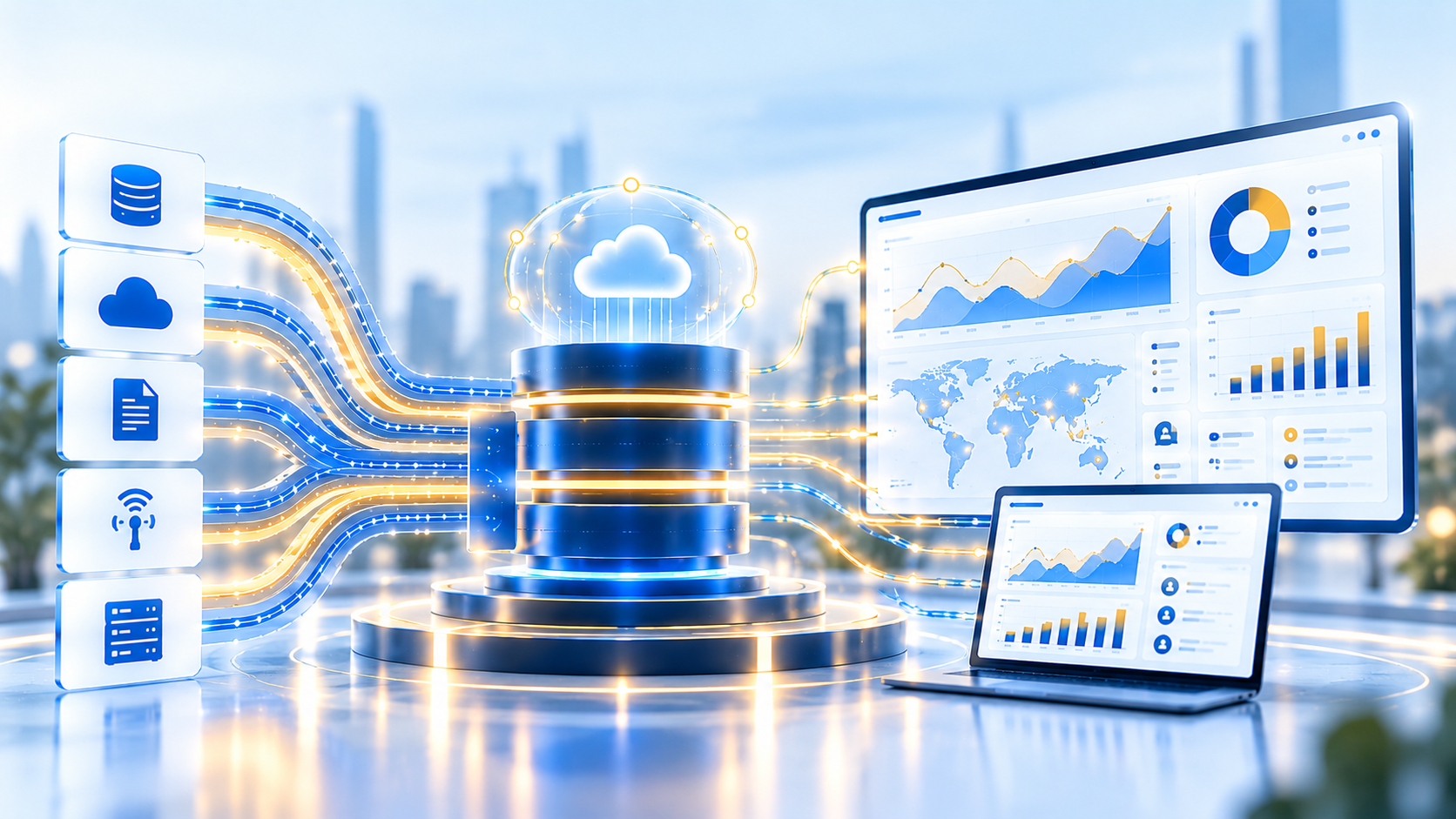
Static reporting reflects what happened yesterday; real-time analytics tells you what is happening right now. We engineer high-velocity data streaming pipelines using event brokers like Apache Kafka and AWS EventBridge.

Legacy on-premises reporting servers struggle under peak concurrent user loads and complex enterprise queries. We architect scalable Cloud BI solutions utilizing platforms like AWS Redshift, Snowflake, Google BigQuery, and Microsoft Azure Synapse.

Moving from descriptive analytics (“what happened”) to predictive and prescriptive intelligence (“what will happen and what action to take”).
Data is an enterprise asset only when it is governed, compliant, and trustworthy.
Our structured engineering lifecycle guarantees high system availability, strict data integrity, and zero operational disruption during deployment:
Evaluating existing source databases, API availability, network constraints, reporting requirements, and compliance boundaries.
Defining target canonical schemas, stream-processing rules, database partitioning, and security policies.
Developing automated extraction scripts, transformation jobs (dbt/Airflow), Kafka event streams, and semantic reporting layers.
Conducting rigorous reconciliation testing, concurrent query benchmarking, and load simulations under peak traffic.
Deploying analytics pipelines in parallel with existing systems to validate data fidelity before executing a seamless cutover.
Implementing real-time monitoring tools (Prometheus, Datadog) to track pipeline health, query response latency, and data drift continuously.
We align our engagement structure with your organization's internal technical capabilities and governance frameworks:
Complete, autonomous pods composed of a Data Architect, Data Engineers, BI Developers, and QA Specialists leading end-to-end strategy and implementation.
Senior Data Architects embedded directly into your IT leadership team to guide platform selection, cloud migration, and governance roadmaps.
SLA-backed 24/7 monitoring, maintenance, schema updating, query tuning, and pipeline optimization.
Traditional BI relies on historical data loaded periodically via batch ETL jobs (e.g., nightly or end-of-month), providing retrospective reports on past performance. Real-Time Analytics processes and evaluates data events instantaneously as they occur within your systems. This enables immediate operational alerts, live monitoring, and automated decision-making without waiting for batch updates.
Top data science and technology organizations look for a multidisciplinary set of core capabilities:
We use phased hybrid migration strategies. By deploying database Change Data Capture (CDC) and secure cloud adapters, we replicate live database updates to cloud data warehouses continuously in the background. This allows new Cloud BI dashboards to be fully validated against production metrics before legacy reporting servers are decommissioned.
In real-time analytics, data quality is critical because bad data can cause immediate ripple effects across operational departments. We implement automated schema validation, range checks, and anomaly detection directly inside the streaming layer. Any malformed payload is instantly redirected to an isolated Dead-Letter Queue (DLQ) for investigation without breaking the main processing stream.
Yes. We design custom embedded analytics interfaces using secure REST APIs, single sign-on (SSO) authentication, and modern web components. This allows your internal teams or external clients to interact with interactive, real-time dashboards natively within your existing software applications.
A traditional Data Warehouse handles structured SQL data efficiently but struggles with unorganized datasets or logs. A Data Lakehouse combines the cost-effective storage flexibility of a data lake with the ACID transactional compliance and fast query performance of a data warehouse, allowing structured, semi-structured, and raw log data to coexist seamlessly for both BI and advanced machine learning.
Security is built natively into every layer of our analytics architecture. We enforce end-to-end encryption (TLS 1.3 in transit, AES-256 at rest), granular Role-Based Access Control (RBAC), row/column-level data security, dynamic PII masking, and continuous audit logging across all cloud storage and query endpoints.
Our team works across modern enterprise tech stacks:
Analytical and visualization queries are strictly isolated from transactional production databases. We stream data changes asynchronously via Change Data Capture (CDC) or event brokers into dedicated analytical engines designed specifically for heavy aggregation queries, protecting live operational databases from performance degradation.
Master Data Management creates a single, standardized definition for core business entities—such as customers, products, suppliers, or accounts—across disparate enterprise tools. Without MDM, different software platforms generate conflicting metrics, leading to inconsistent executive reports and flawed decision-making.
We engineer high-availability, multi-region failover topologies with persistent message queues. If a destination database or reporting server goes offline, incoming streaming events are safely buffered in the message broker layer and processed automatically upon recovery, guaranteeing zero data loss.
Human-in-the-loop BI presents structured insights on visual dashboards for executive review, which can introduce decision delays. Automated decision-making uses trained machine learning models to trigger instant, programmatic operational actions (e.g., dynamic pricing shifts or automated supply reordering) the moment specific real-time streaming thresholds are met.
Targeted real-time streaming connectors or initial cloud BI dashboard builds are typically delivered in 4 to 8 weeks. Comprehensive enterprise-wide data transformations involving legacy data warehouse migrations are executed in phased, risk-mitigated milestones over 12 to 16 weeks.
Enterprise clients achieve ROI through eliminated manual reporting labor, reduced cloud query expenses, accelerated operational workflows, and faster revenue-generating decisions. Most enterprise organizations achieve full cost-parity and positive ROI within 12 to 18 months of deployment.