
Home / Enterprise Data for AI Services
Transform fragmented multi-source enterprise data, unstructured media, and isolated silos into clean, structured, and contextualized AI-ready digital assets. Aurastell engineers end-to-end data pipelines, automated sanitization workflows, vector indexing, and API integrations that power custom machine learning, generative AI, agentic systems, and computer vision models.
Artificial Intelligence has shifted from an experimental technology to the primary driver of enterprise competition. Organizations across logistics, manufacturing, healthcare, and retail are racing to deploy custom Large Language Models (LLMs), Retrieval-Augmented Generation (RAG) architectures, domain-specific machine learning algorithms, and real-time computer vision systems. However, a fundamental truth governs enterprise AI adoption: an AI model is only as intelligent, accurate, and reliable as the data pipeline feeding it.
The primary bottleneck holding back enterprise AI deployments is not model architecture or raw compute capacity, it is data readiness. Operational data is natively noisy, unstructured, fragmented across legacy software silos, and plagued by inconsistent schemas. When raw, unvalidated enterprise data is fed directly into machine learning frameworks or LLM prompts, models produce hallucinations, introduce severe bias, suffer from drift, and create unacceptable compliance risks.
Data for AI is the specialized engineering discipline that bridges the gap between raw enterprise data estates and high-performing AI applications. It encompasses multi-modal data extraction, automated sanitization, semantic enrichment, synthetic data generation, vector store embedding, and real-time API integration pipelines.
At Aurastell, our Data for AI practice converts disconnected enterprise data into decision-grade, context-aware AI assets. By unifying disparate data sources, automating data sanitization, and establishing robust governance frameworks, we ensure your custom AI models train on flawless datasets and execute real-time inferencing with zero latency, complete auditability, and total intellectual property protection.
To train or fine-tune high-value enterprise AI models, software systems must ingest and harmonize diverse data formats scattered across hybrid multi-cloud and on-premises environments. Aurastell specializes in extracting, structuring, and unifying all four primary classes of enterprise data:
SQL, ERP Ledgers, POS, Telematics, Time-Series
JSON Payloads, XML Logs, NoSQL Documents, REST APIs
PDFs, Contracts, Emails, KB Articles, Support Logs
RTSP Video Streams, Images, LiDAR Point Clouds, Audio
Operational data remains trapped in isolated business systems, preventing AI models from accessing a unified operational context:
Transactional ledgers, customer interaction histories, supply chain manifests, and human resource records locked behind proprietary application schemas.
High-frequency machine sensor telemetry, industrial PLC logs, and telematics streams residing on edge devices and factory networks.
Decades of domain expertise stored inside unindexed PDF manuals, standard operating procedure (SOP) documents, legal contracts, and historical customer support tickets.
Real-time closed-circuit television (CCTV) security footage, assembly line inspection camera streams, and medical imaging archives (DICOM).
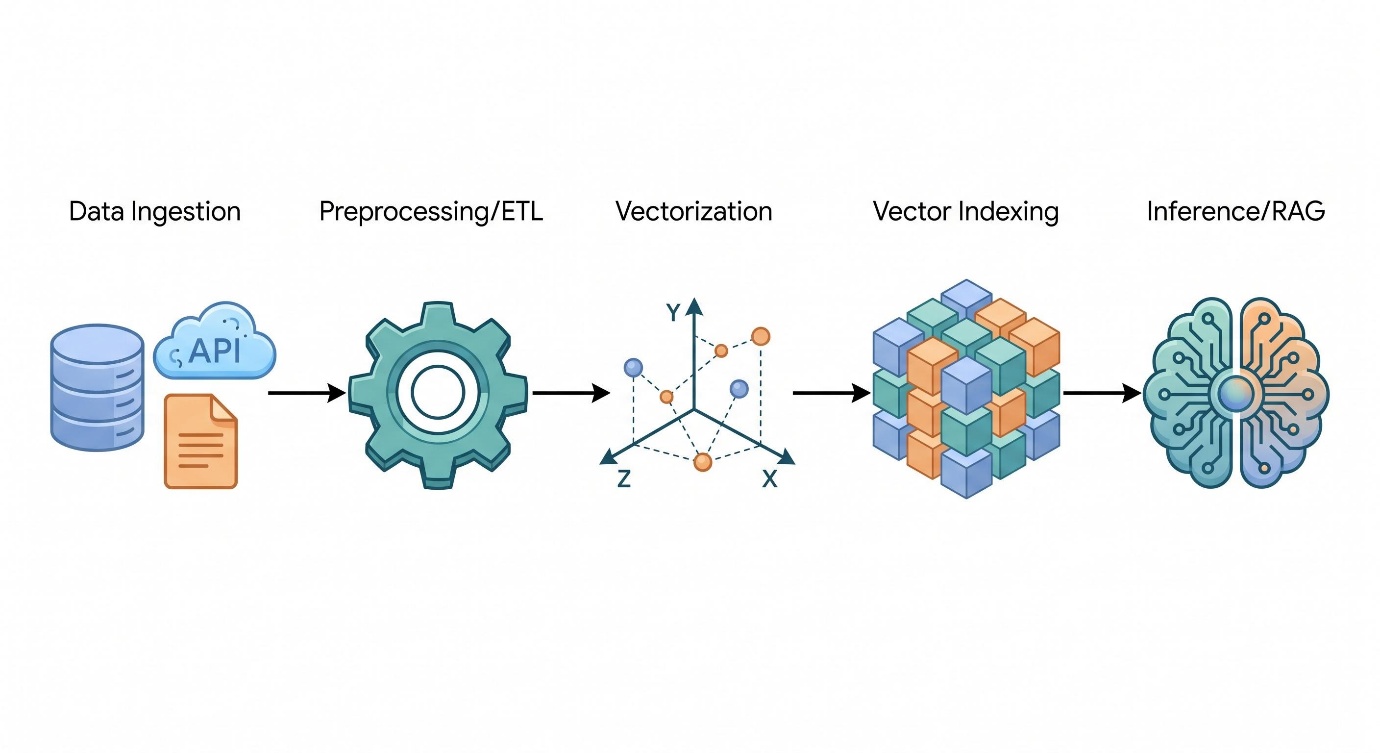
We deploy non-intrusive extraction adapters—including asynchronous Change Data Capture (CDC), zero-copy cloud lakehouse connectors, custom REST/GraphQL/gRPC endpoints, and optical document parsing pipelines. By transforming raw, multi-modal feeds into standardized, canonical schemas, we give custom AI frameworks instant, secure access to your entire organizational data footprint.
Raw enterprise data is naturally messy, containing duplicates, missing values, corrupted formatting, and sensitive Personally Identifiable Information (PII). Aurastell provides a comprehensive, automated data sanitization and transformation pipeline designed specifically for AI/ML workloads:
Standardizing conflicting data types, unit formats (e.g., currency, timezones), and syntax across disparate sources to ensure consistency.
Utilizing statistical profiling and automated clustering to eliminate redundant data entries and isolate corrupted sensor anomalies before model training.
Filling missing values dynamically using algorithmic estimation and domain-specific rules rather than discarding valuable partial records.
Deploying Natural Language Processing (NLP) named-entity recognition (NER) models to scan text, documents, and database records for PII, financial details, or proprietary credentials.
Masking, hashing, or anonymizing sensitive fields in-flight, ensuring AI training runs and third-party LLM APIs never process exposed private data.
Splitting dense, unstructured PDFs, manuals, and contracts into semantically coherent text chunks based on structural headers, paragraphs, and logical topics.
Passing cleansed text chunks through specialized embedding models to generate high-dimensional vector representations stored in specialized vector databases (Milvus, Pinecone, Qdrant).
Generating high-fidelity, privacy-compliant synthetic datasets to train machine learning models on rare operational events or underrepresented edge cases.
An AI data pipeline must operate continuously, feeding live operational metrics into AI inference engines with sub-second latency. Aurastell engineers modern cloud-native architectures that bridge data storage layers with live AI applications:
Building custom, low-latency REST, GraphQL, and gRPC endpoints designed specifically to serve inference payloads and retrieve real-time context for AI agents.
Utilizing event brokers (Apache Kafka, AWS EventBridge) and Change Data Capture (CDC) to stream incremental database changes directly to AI feature stores in milliseconds.
Deploying cloud-agnostic data orchestration frameworks (dbt, Apache Airflow, Ray, Databricks) across AWS, GCP, Azure, or private cloud environments.
Centralizing and versioning curated feature sets using tools like Feast, ensuring feature values during AI model training match feature values served during real-time inference.
Custom AI models engineered on Aurastell’s data foundation deliver transformative commercial advantages across key industry verticals:

The AI Application: Predictive shipment ETA forecasting, automated customs document processing, and dynamic fleet re-routing models.
The Data Challenge: Ingesting chaotic GPS telematics, bills of lading PDFs, port congestion feeds, and weather logs.

The AI Application: Automated computer vision inspection on factory floors and predictive machinery maintenance models.
The Data Challenge: High-frequency vibration telemetry mixed with 60 FPS assembly line video streams causing network bandwidth bottlenecks.
The AI Application: Clinical decision support tools, automated medical record summarization, and diagnostic imaging assistance.
The Data Challenge: Disconnected Electronic Health Records (EHR), unformatted clinical notes, and high-resolution DICOM image files bound by strict HIPAA privacy rules.

The AI Application: Real-time personalized recommendation engines, automated visual search, and dynamic pricing algorithms.
The Data Challenge: Reconciling web clickstream logs, point-of-sale (POS) receipts, catalog images, and inventory databases in real time.
Enterprise leadership faces critical structural roadblocks when attempting to activate operational data for AI. Aurastell systematically solves these obstacles:
Commercial & Operational Risk
AI models generate plausible but inaccurate facts due to noisy, outdated, or incomplete training context.
Commercial & Operational Risk
Employees paste confidential business data or source code into third-party AI prompts, risking IP leaks.
Commercial & Operational Risk
Passing uncompressed, unindexed raw data to AI processing layers drives up cloud bills exponentially.
Commercial & Operational Risk
AI model performance degrades over time as real-world operational data shifts away from original training distributions.
Choosing Aurastell as your Data for AI engineering partner replaces technical friction with guaranteed, measurable business outcomes:
Pre-built data connectors, automated sanitization templates, and ready-to-use vector pipelines accelerate custom AI model deployments by up to 70%.
By offloading data extraction, cleaning, and feature engineering to Aurastell, internal data science teams spend 80% less time wrangling data and 100% of their time building core AI models.
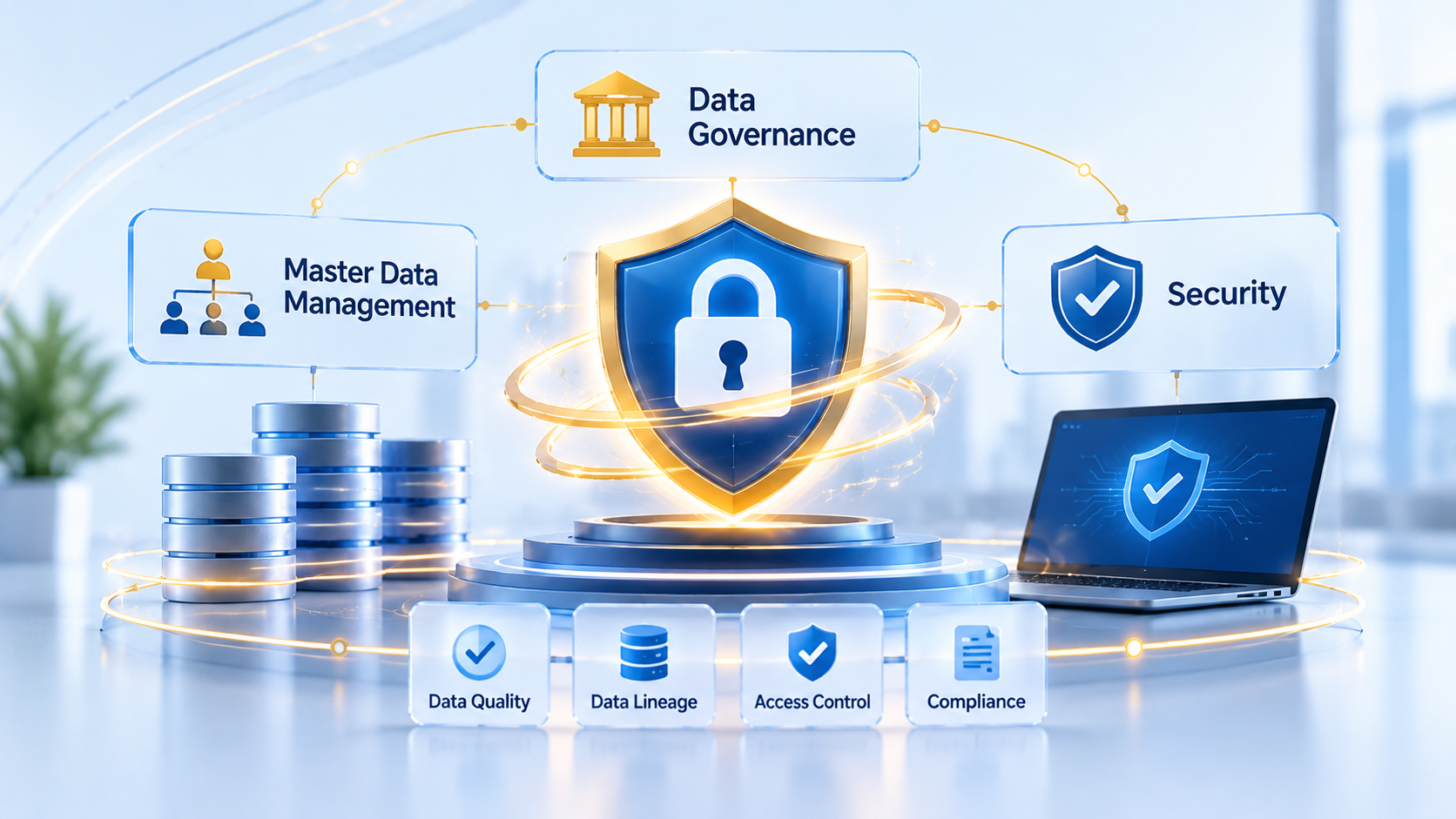
Zero-trust security, mTLS encryption, and automated PII redaction ensure your enterprise intellectual property remains completely protected and compliant.
Intelligent file compaction, vector search optimization, and dynamic compute auto-scaling keep monthly cloud infrastructure bills predictable and controlled.
Our structured engineering lifecycle guarantees high system availability, strict data integrity, and zero operational disruption:
Evaluating existing databases, unstructured file repositories, API readiness, network bandwidth, and target AI model requirements.
Writing OpenAPI specifications, designing canonical schemas, and configuring CDC streaming topics.
Deploying automated data normalization scripts, entity resolution logic, and inline PII redaction pipelines.
Generating high-density vector embeddings, populating vector stores (Milvus/Pinecone), and configuring real-time feature stores.
Connecting clean data pipelines and vector stores to live AI inference engines via secure, low-latency API gateways.
Implementing real-time observability to monitor data drift, pipeline latency, vector query response times, and model accuracy 24/7/365.
Raw enterprise data is messy, inconsistent, and fragmented across isolated databases. Feeding raw data directly into AI frameworks results in inaccurate model outputs, data hallucinations, biased decision-making, and potential security leaks. Enterprise data preparation cleanses, structures, normalizes, and contextualizes raw data so AI models train on high-quality information and generate accurate inferences.
Retrieval-Augmented Generation (RAG) is an AI architecture that enhances Large Language Models (LLMs) by retrieving relevant facts from an enterprise’s private internal databases before generating a response. Data engineering supports RAG by chunking unstructured documents, generating vector embeddings, indexing them in vector databases, and building real-time retrieval APIs that supply exact context to the LLM in milliseconds.
We enforce strict Zero-Trust data privacy boundaries. Before any data payload leaves your private environment to call an external AI API, our pipelines execute automated inline PII discovery, tokenization, and sensitive IP redaction. Furthermore, we deploy private, dedicated vector stores and locally hosted open-source LLMs inside your private cloud perimeter so sensitive data never touches external servers.
A Feature Store is a centralized repository that stores, versions, and serves curated data attributes (features) used to train machine learning models. Data engineers build feature stores to ensure that feature values used during model training match the exact feature values served during real-time production inference, preventing data leakage and model performance degradation.
A spatial Digital Twin requires continuous synchronization between physical equipment and its 3D digital model. Our data engineering pipelines build high-frequency IoT streaming streams (via MQTT or Kafka) that process vibration, thermal, and operational metrics in real time, projecting those live data points directly onto 3D spatial models with sub-second latency.
Computer vision pipelines process massive volumes of high-frequency, unstructured media assets—such as RTSP camera video streams, high-resolution images, and 3D LiDAR point clouds. Data engineering for computer vision requires specialized edge-to-cloud frame extraction, automated bounding-box image annotation pipelines, and high-throughput vector indexing optimized for visual spatial embeddings.
Synthetic data generation uses statistical algorithms or AI models to generate artificially created datasets that mathematically mimic real-world enterprise data without containing real user records. Enterprises use synthetic data to train AI models on rare operational edge cases (such as factory equipment breakdowns) or when real data is restricted by severe privacy regulations.
We deploy specialized optical character recognition (OCR), document layout parsers, and Natural Language Processing (NLP) pipelines. These tools extract text, tables, and metadata from raw PDFs or image scans, converting them into structured JSON payloads and chunked text blocks ready for vector embedding and LLM indexing.
CDC pipelines capture database changes asynchronously as they happen and stream incremental updates to AI feature stores in milliseconds. This ensures that live AI inference engines (such as dynamic pricing or fraud detection models) make decisions based on real-time operational state rather than stale, hours-old batch reports.
Our practice is completely platform-agnostic and relies on enterprise-proven technologies:
We deploy real-time DataOps telemetry tools that continuously monitor the statistical distribution of incoming operational data. When statistical drift is detected between live data and original training datasets, automated alerts trigger re-indexing or automated model re-training pipelines to maintain model precision.
Deployment timelines follow a structured schedule:
We conduct a pre-project evaluation that quantifies time saved by internal data scientists, reductions in LLM API token costs due to intelligent context chunking, eliminated manual data preparation labor, and revenue gains from deployed AI applications. Most enterprise clients achieve full cost-parity and positive ROI within 6 to 12 months.
We engineer idempotent pipeline architectures with persistent messaging queues and automated retry mechanisms. If a downstream vector store or AI API experiences a service interruption, incoming data payloads are safely buffered in persistent event queues and processed in exact sequential order upon recovery.